On Fingerspitzengefühl
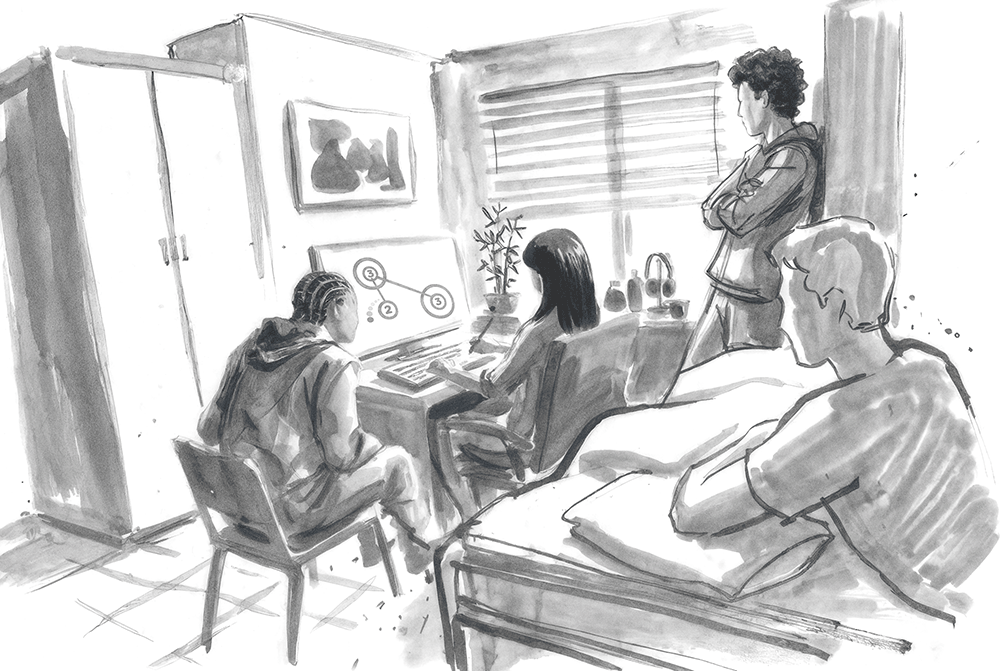
I used to play this rhythm game called osu! from ages 11 to 17. You might've seen clips of people reacting to it. The concept is simple: you click circles to the beat of a song. Most players aim with a graphic tablet and tap with Z + X on their keyboard. I played semi-competitively around 2020-2022.
I missed the stress of it. The split-second decisions when you're about to ace a map no one in the country aced. So I dusted off my tablet, dug up my old settings from old Discord channels, and booted up the game.
I invited friends to my dorm to try it. I expected 3 or 4 to show up. 22 did. Most didn't care about getting good. They picked up the pen, laughed at circles flying across the screen, and had a good time (I hope). But a few were regulars to these hangouts and started noticeably improving. Watching them reminded me of my own experience learning the game back in the day.
It got me thinking about what actually makes people improve, and why it's so hard to help.
Getting better feels like manually breathing
Fingerspitzengefühl (finger-shpit-sen-guh-fool) is German for "fingertip feeling." It describes the intuitive sense people develop for knowing exactly what to do in a situation they're experienced in. Knowledge you have but can't fully articulate. Anyone who watches Messi navigate tight defenses sees it. He just knows where the path is and has a touch for the ball that few can replicate.
I started osu! with zero rhythm knowledge. Never played an instrument. Never played any games competitively. I could barely pass 2-star maps with a D rank. Thinking about what I was doing felt like too much effort, so I shut my brain off and let reflexes take over.
When I saw a hard pattern, I'd decide I was guaranteed to miss 1-2 circles and just accept it since I'd still pass. I eventually got better, but this habit carried on until I was top 5K global.
Players like bloo and eternum eventually caught onto it. They told me to care about every single circle. Take it slow; ignore the whole pattern. Just focus on hitting each circle individually. I remember staying in voice chat with bloo retrying the same niche pattern 100+ times until I felt what it's like to take a pattern "one circle at a time".
It felt wrong. It was similar to the feeling when someone reminds you that you're breathing. Suddenly you're manually breathing, consciously controlling something that should be involuntary. My thoughts used to flow on autopilot during play. To get better, I had to control them manually because they were flowing in the wrong direction.
But it worked. Ignoring the pattern and focusing on each circle made me less complacent. Over time, the manual control became automatic again, just pointed somewhere better.
Where you start determines the peak you can reach
Imagine a landscape where your position is how you play and your height is your skill level. You naturally move uphill. But the landscape has multiple peaks. Once you reach the top of the nearest one, small adjustments can't get you any higher. You need to come back down and start climbing a different, taller peak. Think of a basin as a valley. Which valley you're in determines which peaks you can reach.
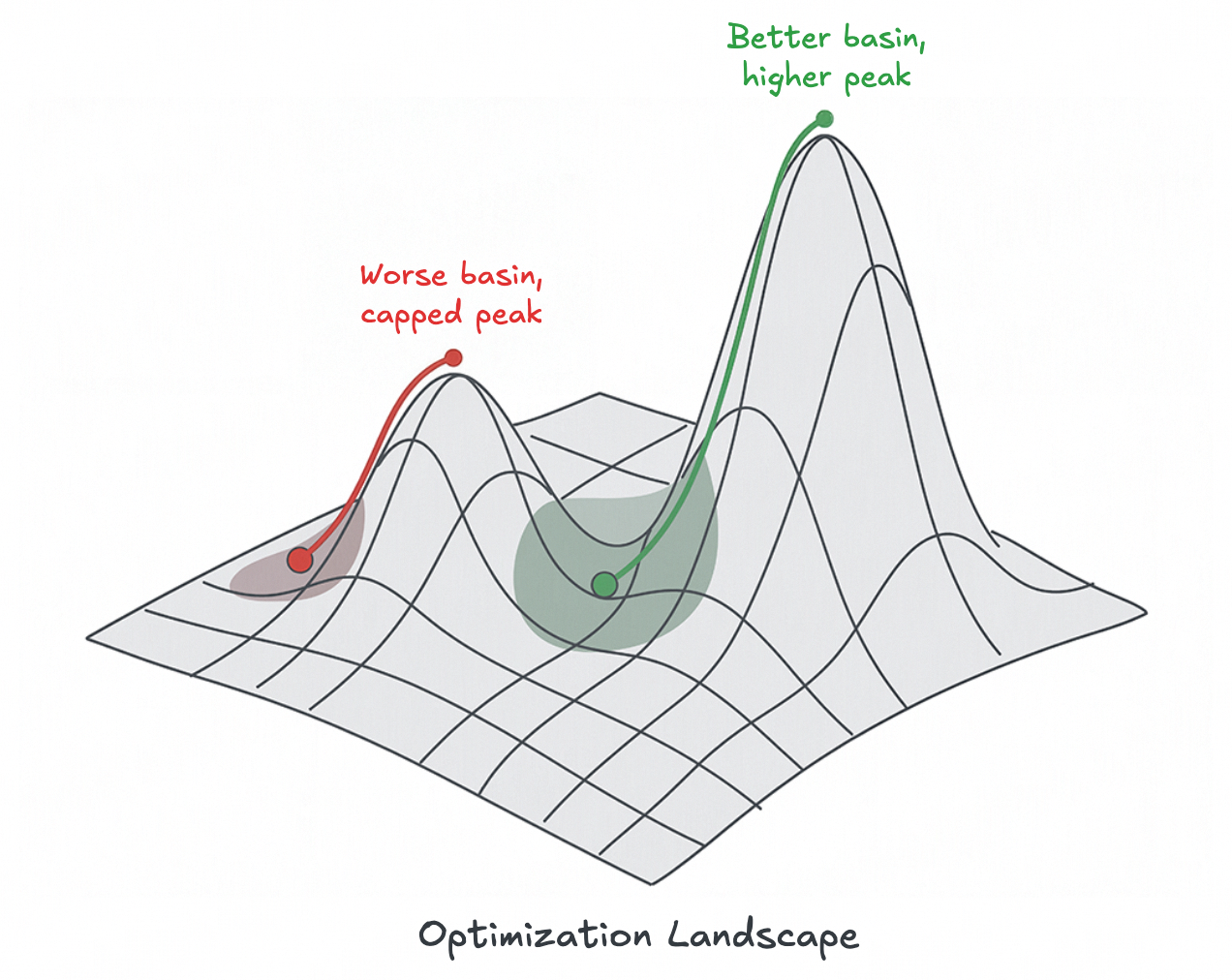 An optimization landscape with multiple peaks. Without guidance, a player climbs the nearest local maximum. A good pointer moves them to a starting position with access to a higher peak.
What bloo and eternum did wasn't teach me technique. They moved me to a different starting position. "Care about every circle" didn't make me better at aiming per se. But it put me in a different basin entirely, one where the peak was higher.
For my friends who regularly visited, some shifts were mechanical. A lot of people kept their wrist hovering above the tablet. Planting it on the desk made their aim more stable immediately. A hovering wrist caps your potential no matter how much you practice. That's a low-peak basin.
Other shifts were mental. A lot of people reacted to each circle as it appeared. Once I pointed out that the tempo is consistent and already tells you when the next circle is coming, they stopped reacting and started anticipating. That alone moved them to a different, higher potential basin.
But none of this works unless someone cares enough to enter manual breathing mode. Most don't care enough to improve on a silly circle-clicking game, and that's completely fine. I view pace of improvement as a function of how much you care. Neither advice nor help can never substitute the sleepless nights you have to endure to improve.
Most of what you know gets lost in translation
After years of playing, I've built some fingerspitzengefühl in osu!. I can feel when my aim is too stiff. When my tapping is off-tempo. But I can't fully explain how I know or how I adjust.
Take aim stiffness. My understanding of it involves wrist angle, grip pressure, pen height, movement speed, how I track circles, when I snap vs. glide. There's even more I can only feel mid-game but can't name. That's a lot to hold at once. But when I try to explain it, all of it becomes "your aim is too stiff." Five words. Most of what I know doesn't survive.
My understanding is high-dimensional. Language is low-dimensional. Most of what I know gets lost in translation.
But even those five words land differently depending on who hears them. A beginner hears "your aim is too stiff" and has nothing to map it to. Someone who's felt their wrist lock up mid-play reconstructs the full picture from the same phrase.
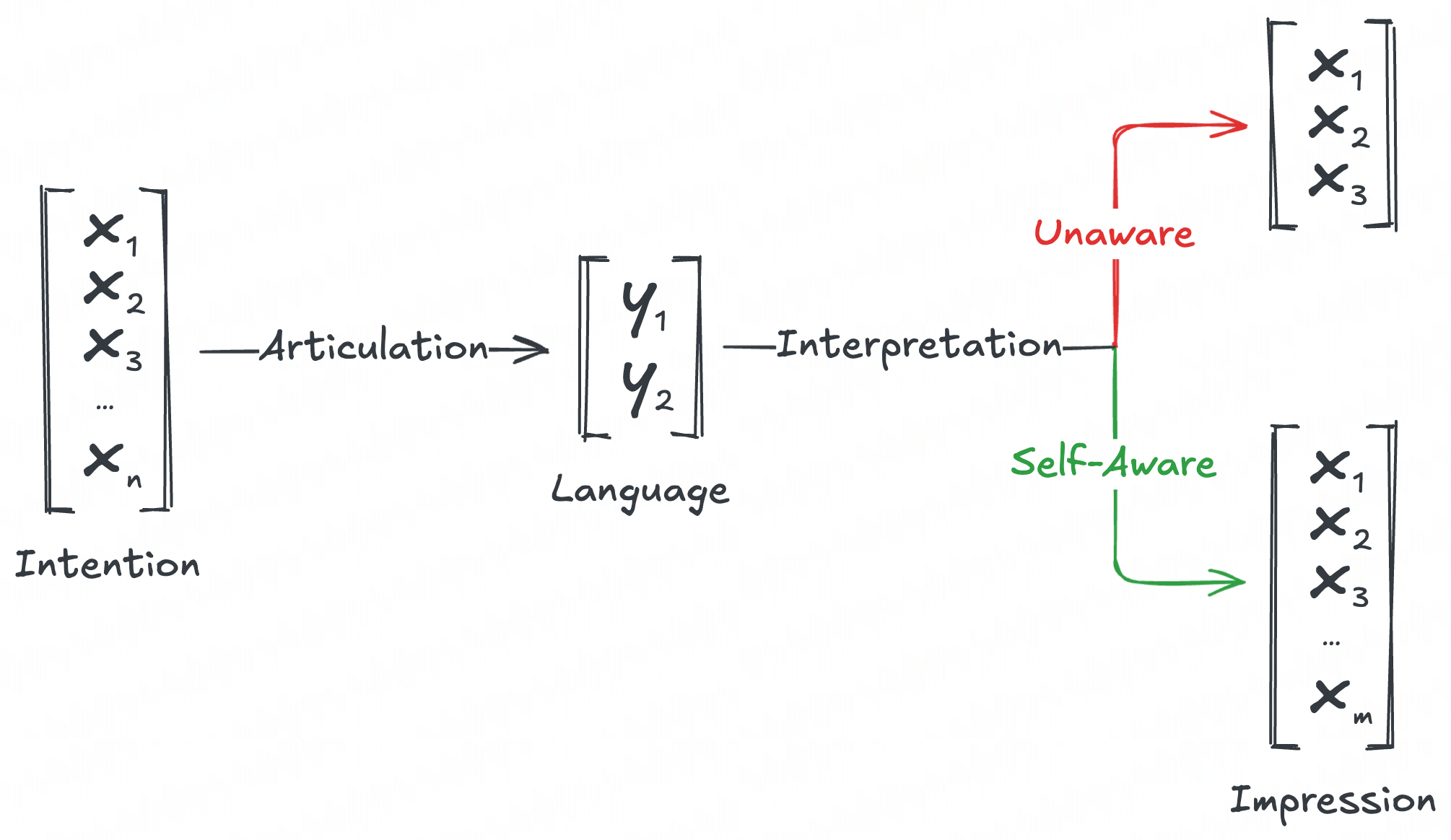 A high-dimensional understanding gets compressed into words. A self-aware receiver reconstructs a richer signal from the same phrase than a beginner can.
So there are two bottlenecks. The first is articulation: how much the sender preserves when compressing into language. The second is interpretation: how much the receiver reconstructs.
I've been on both sides of this. When I was starting out, advice like "stay focused" was noise. I heard it but couldn't map it to anything I felt. When bloo told me to care about every circle, it only landed because I had enough awareness to feel what complacency was doing to my play. I could decode the pointer.
You can't transfer fingerspitzengefühl through language. The signal is too high-dimensional and the channel is too narrow. The best you can do is point someone to the right basin. You can't climb it for them. If they care enough to enter manual breathing mode, they'll find their way to the peak.
P.S. Shout out to AA, AC, AL, AM, AT, CB, CC, EB, FM, HT, IM, IV, KC, MI, MM, MS, NP, NS, PL, RH, SP, and VC for pulling up to my dorm to play. If you're at Duke and are interested, feel free to hit me up on Instagram!